
- 2026 Release Notes
- October 2026
- September 2026
- August 2026
- July 2026
- Attack Surface Insights
- Automation Management
- Cloud Collectors
- Dashboards
- Log Sources
- Log Stream
- New-Scale Platform
- Outcomes Navigator
- Search
- Site Collectors 2.21
- Threat Center
- Threat Detection Management
- Resolved Issues
- Site Collector 2.21: Resolved Issues
- Site Collector 2.21: Security Vulnerabilities Remediations
- June 2026
- Attack Surface Insights
- Automation Management
- Cloud Collectors
- Context Management
- Correlation Rules
- Dashboards
- Log Stream
- New-Scale Platform
- Outcomes Navigator
- Search
- Service Health and Consumption
- Site Collectors 2.20
- Threat Center
- Threat Detection Management
- Resolved Issues
- Site Collector 2.20: Security Vulnerabilities Remediations
- May 2026
- April 2026
- March 2026
- February 2026
- January 2026
- 2025 Release Notes
- December 2025
- November 2025
- October 2025
- September 2025
- August 2025
- July 2025
- June 2025
- May 2025
- April 2025
- March 2025
- February 2025
- January 2025
- Known Issues
August 2026
The New-Scale Security Operations Platform includes the following addressed features and new features for August 2026.
Attack Surface Insights
Feature | Description |
|---|---|
Security Criticality Distribution Chart | To streamline the Overview tab, you can now view the number of user and device entities assigned each security criticality under a single Security Criticality Distribution chart. 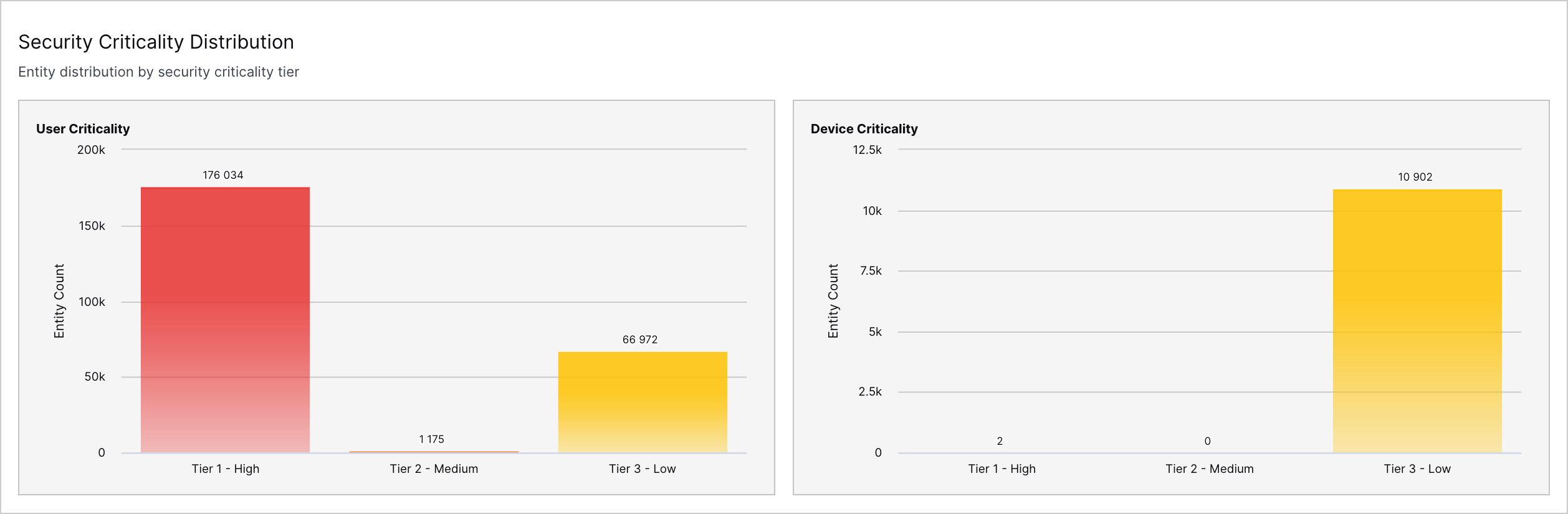 |
Scheduled Updates for Overview Charts | To improve performance, all charts in the Overview tab, except Entities by Tags, are now scheduled to refresh once every 24 hours. You can now see the date and time the charts were last updated at the top of the Overview tab. 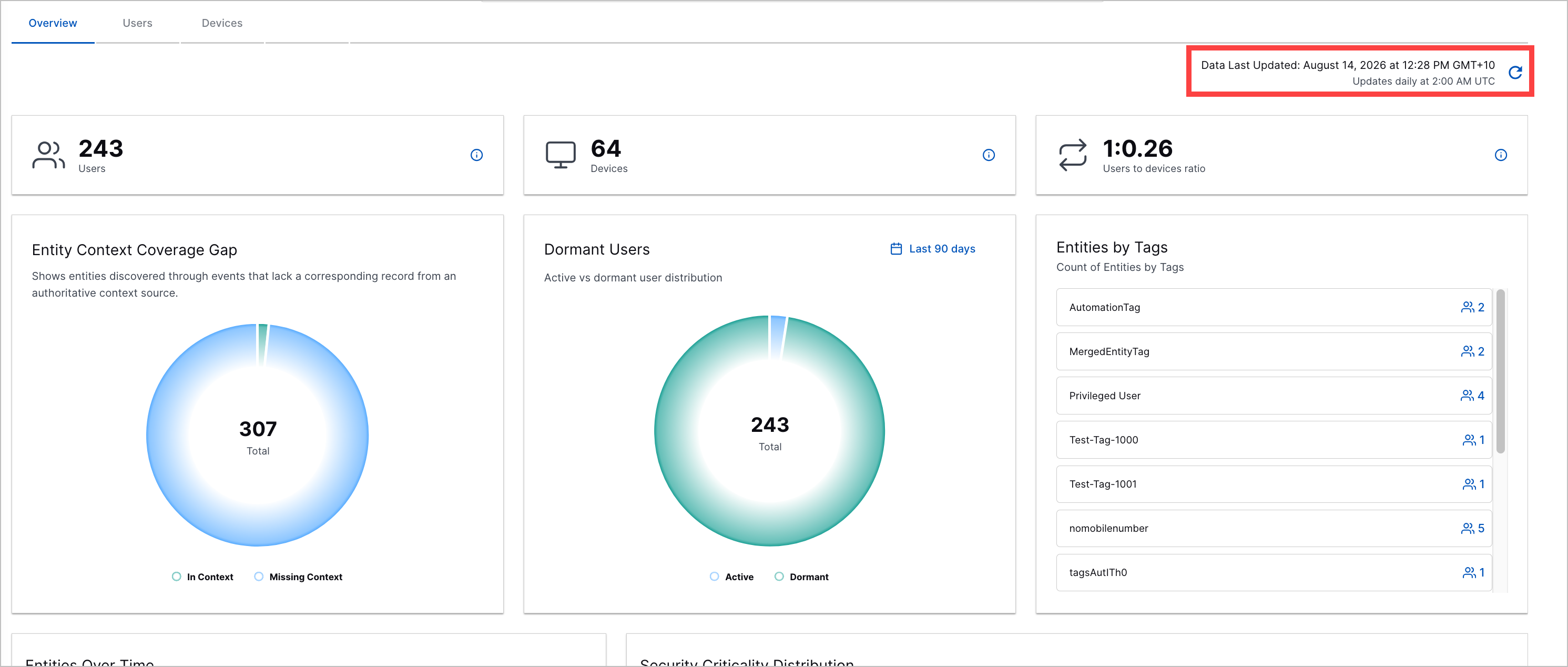 To immediately refresh all charts, you can click |
Linking Exclusions Using User Entity Do-Not-Link Pre-Built Context Table | You can now prevent user identities from linking and create standalone entities using a new pre-built context table, the User Entity Do-Not-Link context table. By default, the User Entity Do-Not-Link context table has one column, User Entity Do Not Link Id. The value of each row should follow a specific format: SourceContextField:::SourceValue:::TargetContextField::::TargetValue. Entities containing the source field and source value will never link with entities containing the target field and target value.  You can use the Java flavor of regular expressions in the source value and target value, with some limitations. To indicate an expression should be treated as regex, you use the following syntax: #{expression}#. Standalone entities not linked to any other entities are still enriched with relevant context data. |
Regular Expressions in the User Entity Links Pre-Built Context Table | To link user identities using pattern matching, you can now use regular expressions in the pre-built User Entity Links context table. You can use the Java flavor of regex only in the source value. To indicate an expression should be treated as regex, you use the following syntax: #{expression}#. If you use a capture group in the source value, you can substitute the capture group in the target value using the syntax $(#), where # represents the group number. To test a regular expression used in the context table, you can enter the expression as a query in Attack Surface Insights search. |
Increased Entity Attribute Character Limit | To ensure entity attributes fully capture incoming event and context data, the character limit for string type attributes has been increased to 512. String-type entity attribute values above 512 characters are truncated. |

Cloud Collectors
Feature | Description |
|---|---|
AWS Eventbridge Cloud Collector | The AWS Eventbridge Cloud Collector is now available as part of Cloud Collectors to facilitate ingestion of events that are routed via Amazon EventBridge rules for the selected AWS sources on the configured target SQS queue. |
AWS Shield Cloud Collector | The AWS Shield Cloud Collector is now available as part of Cloud Collectors to facilitate ingestion of AWS DDoS attack flow logs and event data. |
Egnyte Cloud Collector | The Egnyte Cloud Collector is now available as part of Cloud Collectors to facilitate ingestion of Egnyte audit logs that track data activity, user behavior, and system administration. |
Symantec Email Security Collector | The Symantec Email Security Collector is now available as part of Cloud Collectors to facilitate ingestion of Symantec Email Security Cloud logs. |
Symantec Cloud Secure Web Gateway Cloud Collector | The Symantec Cloud Secure Web Gateway Cloud Collector is now available as part of Cloud Collectors to facilitate ingestion of Symantec Secure Web Gateway (SWG) logs. |
Collector Metadata Enhancement | Cloud Collectors now include a metadata field m_collector_id as part of each event fetched by collectors. This unique value can be utilized across a variety of use cases, including OpenAPI requests and targeted searches. Fetched logs can be searched instantly using this identifier. |
Google Workspace Context Cloud Collector | The Google Workspace Context Cloud Collector is now available as part of Cloud Collectors to facilitate ingestion of user context data. |
REST API Context Cloud Collector | The REST API Context Collector is now available as part of Cloud Collectors to facilitate ingestion of context data from REST API endpoints from a broad range of vendors and products. |
Armis Cloud Collector | The Armis Cloud Collector is now available as part of Cloud Collectors to facilitate ingestion of alerts logs from Armis. |
Armis Context Cloud Collector | The Armis Context Cloud Collector is now available as part of Cloud Collectors to facilitate ingestion of context data from Armis. |
AWS Inspector Cloud Collector | The AWS Inspector Cloud Collector is now available as part of Cloud Collectors to facilitate ingestion of data from Amazon Inspector. |
AWS Redshift Cloud Collector | The AWS Redshift Cloud Collector is now available as part of Cloud Collectors to facilitate ingestion of Redshift cluster management events from Amazon Redshift. |
Cybereason Cloud Collector | The Cybereason Cloud Collector is now available as part of Cloud Collectors to facilitate ingestion of Cybereason logs. |
Google Security Operations Cloud Collector | The Google Security Operations Cloud Collector is now available as part of Cloud Collectors to facilitate ingestion of all supported default and custom logs from your Google SecOps account. |
Palo Alto SaaS Security Cloud Collector | The Palo Alto Networks SaaS Security Cloud Collector is now available as part of Cloud Collectors to facilitate ingestion of SaaS Security log events. |
Symantec CloudSOC Cloud Collector | The Symantec CloudSOC Cloud Collector is now available as part of Cloud Collectors to facilitate ingestion of Symantec CloudSoc logs that include Investigate Service App logs, Detect App (Incidents) logs and Investigate App logs. |
Early Access Cloud Collector | |
Claud Enterprise Cloud Collector | The Claud Enterprise Cloud Collector is now available as part of Cloud Collectors early access program to facilitate ingestion of logs from Claude Compliance API. The early access program offers you an opportunity to gain access to the latest cloud collectors before their official release. To participate, see Sign Up for the Early Access Program. |
Context Management
Feature | Description |
|---|---|
REST API Context Tables |  Context Management now supports custom context tables based on REST API cloud collectors. These context tables can contain user, device, or other data type attributes. In the Cloud Collector service, the available REST API collectors have been expanded to include both log and context sources. The REST API Context collector simplifies integration with custom REST API context sources, independent of any pre-built, vendor-specific cloud collector or external development. On the Context Management side, the new REST API context tables process data ingested by the corresponding REST API Context Cloud Collector. These context tables do not map, by default, to a set of specific context attributes. Instead, you have full flexibility to customize the attribute mapping for any of the source attributes returned by the API response in the collector. For more information about REST API data collection, see the following references:
|
Support for Array-based Filtering | A new Array Contains operator has been added to Context Management filtered tables functionality. When creating or editing a custom filtered context table, this new operator supports condition filtering based on data in array attributes. The Array Contains operator can be used only on array attributes. It returns records from the parent tables only when the array attribute contains a specific filter value. 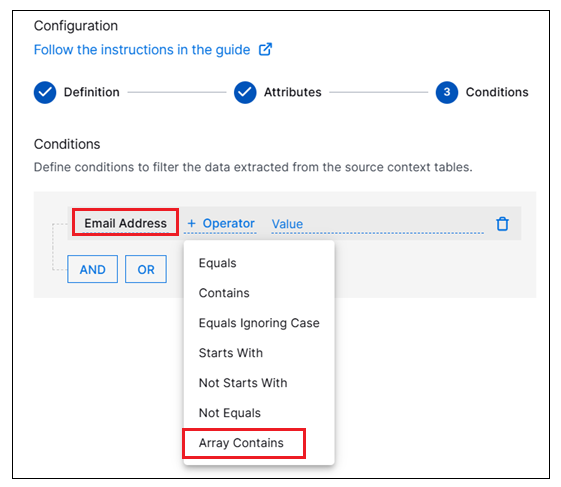 For more information about configuring filter conditions, see Working with Filtered Context Tables in the Context Management Guide |
Default Values Added for ABA Pre-Built Context Tables | Context Management includes a number of pre-built Agent Behavior Analytics (ABA) context tables that provide context for detection activities related to the use of AI tools in your environment. Previously, these tables were empty by default and could only be used after they were manually populated with values. To improve both convenience and coverage, some of these context tables are now populated, by default, with a pre-defined set of values. The pre-defined values include the most commonly used AI applications, web domains, and rulesets your environment might encounter. The following context tables now contain a default set of pre-defined values:
For more information about these context tables, see Pre-Built Agent Behavior Analtyics Context Tables in the Context Management Guide. |
Dashboards
Feature | Description |
|---|---|
Support for Role-Based Control of Dashboard Access | Role-based access control (RBAC) has been introduced in the Dashboards service. These controls allow you to restrict permissions, at the individual dashboard level, based on user roles. Available permissions include:
For more information see User Management in the Dashboards Guide. |
Log Stream
Feature | Description |
|---|---|
Support for Read Only Access to Log Stream | A new read-only permission level has been added that grants access to Log Stream without the ability to make modifications. User roles assigned the new read-only level of permissions can log in and view information on every tab of the Log Stream application. These users can view the status and details about parsers, parser updates, enrichment rules, and event filters. But on each tab, options that would permit editing or creating anything new are unavailable. 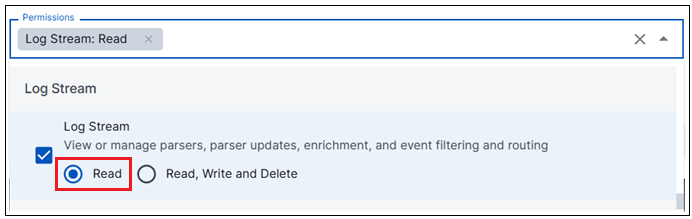 For more information Log Stream access levels, see Access Log Stream in the Log Stream Guide. |
New Public APIs for Log Stream | You can now programmatically manage parsers, event builders and event enrichers via a new set of public API endpoints for Log Stream. These new public APIs expose endpoints that allow you to create, update, generate lists, and delete. All of the available Log Stream API endpoints start with the following base URL: For an overview of the available endpoints, see Log Stream APIs in the Log Stream Guide. For specific information about the request and response parameters, visit the Exabeam API Reference Guide and use the left navigation panel to find the Log Stream endpoints. |
New-Scale Platform
Feature | Description |
|---|---|
Exabeam MCP Server Email Notifications | Security analysts and AI agents performing triage sessions need to push structured findings and summaries to stakeholders via email without leaving their workflow. You can now send emails of triage activity to be delivered to directly to configured recipients. Example: "Get a list of the latest cases and send an email to [email protected]" For more information about the Exabeam MCP Server, refer to Connect to Exabeam MCP Server in the New-Scale Security Operations Platform Administration Guide. |
Site Collectors 2.22
Feature | Description |
|---|---|
Streamlined Deployment and Hardened Protection | Security hardening has been enhanced and streamlined for seamless deployment. Additionally, a vast number of vulnerabilities have been successfully resolved to strengthen the overall security. |
Early Access Features | |
Direct Access Agent Management API Expansion | Direct Access Agent Management API now provides extended API capabilities to ensure seamless, unrestricted integration with the New-Scale Security Operations Platform. Public API support is introduced to empower teams to effortlessly automate security workflows and integrate existing tools. |
Support for MS SQL Server Kerberos Authentication | Site Collectors now support MS SQSL Sever Database Kerberos authentication. Previously, users were limited to basic login and password authentication for MS SQL Server databases, creating a need for policy exceptions. To eliminate this, MS SQL Server Kerberos authentication is now fully supported for MS SQL collector. With this enhancement, Windows Active Directory can be utilized to seamlessly manage both standard users and service accounts for all database connections. |
Refer to the following table for collector versions for Site Collectors 2.22.
Collector / Component | Product Version |
|---|---|
Direct Access Agent (DAA) Collector | 1.6 |
Threat Center
Feature | Description | |
|---|---|---|
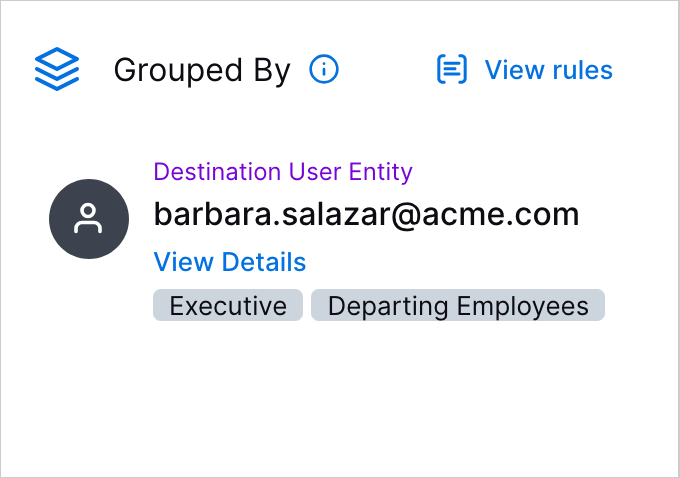
Attack Surface Insights Entity Tag Enhancement | To clearly distinguish Attack Surface Insights entity tags from case and alert tags, you can now view entity tags alongside the entity with which they are associated.
The tags shown are the ones that are associated with the entity when the alert was created. If you add or remove a tag from the entity, the changes aren't reflected in the case or alert. Entity tags are no longer presented alongside case or alert tags in the Threat Center application. | |
Watchlist Performance Enhancement | To improve watchlist response time and reliability, you can now create watchlists using the entity tags associated with the entity when an alert was created. An entity appears in all corresponding watchlists even if its tags change between alerts. For example, if an entity has tag1 in Alert 1 and tag2 in Alert 2, it appears in both the watchlist created based on tag1 and the watchlist created based on tag2. |
Threat Detection Management
Feature | Description |
|---|---|
New Analytics Rule Time Functions | In analytics rules configurations, you can now retrieve the date and time an event occurred using three new functions:
|
Updated Pre-Built Analytics Rules | You can now better detect persistent unauthorized access, evasion, malicious execution on endpoints, and data exfiltration with updated pre-built analytics rules. To prevent over-triggering on first-time observations and to establish a good baseline, NoteChanges to If an analytics rule has already been enabled for more than 14 days, changes to
To filter the events an analytics rule assesses and improve efficiency,
To normalize letter cases and improve reliability,
To fix an issue with querying for analytics rules in Search,
To more accurately reflect the threats the analytics rule is intended to detect,
To ensure analytics rules reference valid use cases,
To ensure field values are in the correct format and are within valid ranges,
To ensure double slashes in URLs aren't normalized to single slashes,
To ensure double slashes in URLs aren't normalized to single slashes,
To ensure the analytics rule triggers on all LSASS memory-reading activities,
To minimize false positives and precisely match exact parent process names,
To ensure the analytics rule detects when a NTDS process is executed with its full extension or name,
To improve analytics rule effiency and remove a redundant condition already accounted for in other analytics rule fields,
To improve analytics rule effiency and remove a redundant condition already accounted for in other analytics rule fields,
To remove a trailing space,
|
Resolved Issues
Correlation Rules
Issue ID | Description |
|---|---|
ENG-102035 | If you changed the name of a correlation rule, then navigated to associated rule trigger events in Search by clicking To ensure the Search query returns rule trigger events for a specific correlation rule, even if its name changes, the link to Search now queries using the correlation rule ID. |

Log Stream
Issue ID | Description |
|---|---|
ENG-92107 | In some environments, rule trigger events from Advanced Analytics raw logs were difficult to find in New-Scale Search. This issue is caused because the format for rule trigger events in Advanced Analytics is different from the expected format in New-Scale. Finding rule trigger events becomes more complicated and requires different query syntax to find rule triggers in raw logs from both Advanced Analytics and New-Scale. To resolve this issue and simplify the search process, the format for rule trigger events in Advanced Analytics has been standardized to match the expected New-Scale format. Now Log Stream can parse rule trigger events for consistent handling in Advanced Analytics, New-Scale Analytics, and Correlation Rules engines. |
Site Collector 2.22: Security Vulnerabilities Remediations
The Site Collectors 2.22 (August 2026) release includes remediated security vulnerabilities. For more information about Exabeam’s commitment to remediating vulnerabilities for Site Collector, see the Vulnerability Remediation Policy.
There are no open known CVEs in any container image (Nifi). Toolkit has been deprecated and is no longer in use hence no security vulnerabilities update is available for that.
The following table lists the CVEs remediated for the Nifi container and their severity.
Critical | High | Medium |
|---|---|---|
Total: 41 | Total: 312 | Total: 261 |
CVE-2026-10536 CVE-2026-11564 CVE-2026-11856 CVE-2026-25702 CVE-2026-39821 CVE-2026-52914 CVE-2026-52924 CVE-2026-52931 CVE-2026-52955 CVE-2026-52958 CVE-2026-52982 CVE-2026-52986 CVE-2026-52989 CVE-2026-52993 CVE-2026-52999 CVE-2026-53002 CVE-2026-53006 CVE-2026-53010 CVE-2026-53043 CVE-2026-53045 CVE-2026-53046 CVE-2026-53049 CVE-2026-53055 CVE-2026-53086 CVE-2026-53088 CVE-2026-53131 CVE-2026-53151 CVE-2026-53175 CVE-2026-53176 CVE-2026-53186 CVE-2026-53215 CVE-2026-53216 CVE-2026-53221 CVE-2026-53224 CVE-2026-53225 CVE-2026-53228 CVE-2026-53246 CVE-2026-53247 CVE-2026-53260 CVE-2026-53309 CVE-2026-5450 | CVE-2013-7445 CVE-2018-12930 CVE-2018-12931 CVE-2019-14899 CVE-2019-15794 CVE-2019-19378 CVE-2019-19814 CVE-2019-20426 CVE-2020-26560 CVE-2021-26934 CVE-2021-3864 CVE-2022-0400 CVE-2022-1247 CVE-2022-25265 CVE-2022-25836 CVE-2022-2961 CVE-2022-3238 CVE-2022-45885 CVE-2022-50090 CVE-2022-50240 CVE-2022-50551 CVE-2023-0030 CVE-2023-26242 CVE-2023-33053 CVE-2023-3397 CVE-2023-3640 CVE-2025-1272 CVE-2025-54518 CVE-2026-11352 CVE-2026-11586 CVE-2026-12064 CVE-2026-27145 CVE-2026-31786 CVE-2026-31787 CVE-2026-33814 CVE-2026-40355 CVE-2026-40356 CVE-2026-4046 CVE-2026-41992 CVE-2026-42504 CVE-2026-43490 CVE-2026-43495 CVE-2026-43497 CVE-2026-43498 CVE-2026-43502 CVE-2026-4437 CVE-2026-45837 CVE-2026-45839 CVE-2026-45843 CVE-2026-46055 CVE-2026-46105 CVE-2026-46107 CVE-2026-46110 CVE-2026-46111 CVE-2026-46112 CVE-2026-46113 CVE-2026-46114 CVE-2026-46116 CVE-2026-46117 CVE-2026-46120 CVE-2026-46121 CVE-2026-46122 CVE-2026-46123 CVE-2026-46124 CVE-2026-46125 CVE-2026-46129 CVE-2026-46130 CVE-2026-46133 CVE-2026-46136 CVE-2026-46138 CVE-2026-46140 CVE-2026-46145 CVE-2026-46149 CVE-2026-46150 CVE-2026-46152 CVE-2026-46154 CVE-2026-46157 CVE-2026-46162 CVE-2026-46163 CVE-2026-46164 CVE-2026-46166 CVE-2026-46173 CVE-2026-46174 CVE-2026-46175 CVE-2026-46176 CVE-2026-46177 CVE-2026-46178 CVE-2026-46180 CVE-2026-46181 CVE-2026-46183 CVE-2026-46189 CVE-2026-46190 CVE-2026-46191 CVE-2026-46197 CVE-2026-46198 CVE-2026-46199 CVE-2026-46201 CVE-2026-46203 CVE-2026-46204 CVE-2026-46205 CVE-2026-46206 CVE-2026-46208 CVE-2026-46209 CVE-2026-46210 CVE-2026-46212 CVE-2026-46213 CVE-2026-46215 CVE-2026-46218 CVE-2026-46219 CVE-2026-46227 CVE-2026-46230 CVE-2026-46232 CVE-2026-46234 CVE-2026-46238 CVE-2026-46240 CVE-2026-46241 CVE-2026-46242 CVE-2026-46273 CVE-2026-46274 CVE-2026-46275 CVE-2026-46293 CVE-2026-46294 CVE-2026-46299 CVE-2026-46301 CVE-2026-46303 CVE-2026-46304 CVE-2026-46306 CVE-2026-46307 CVE-2026-46308 CVE-2026-46309 CVE-2026-46311 CVE-2026-46317 CVE-2026-46319 CVE-2026-46320 CVE-2026-46321 CVE-2026-46322 CVE-2026-46324 CVE-2026-46331 CVE-2026-52908 CVE-2026-52909 CVE-2026-52910 CVE-2026-52911 CVE-2026-52912 CVE-2026-52915 CVE-2026-52917 CVE-2026-52918 CVE-2026-52919 CVE-2026-52920 CVE-2026-52922 CVE-2026-52923 CVE-2026-52927 CVE-2026-52929 CVE-2026-52932 CVE-2026-52934 CVE-2026-52935 CVE-2026-52942 CVE-2026-52943 CVE-2026-52947 CVE-2026-52950 CVE-2026-52951 CVE-2026-52952 CVE-2026-52953 CVE-2026-52954 CVE-2026-52956 CVE-2026-52957 CVE-2026-52959 CVE-2026-52960 CVE-2026-52967 CVE-2026-52969 CVE-2026-52971 CVE-2026-52973 CVE-2026-52974 CVE-2026-52975 CVE-2026-52976 CVE-2026-52981 CVE-2026-52983 CVE-2026-52987 CVE-2026-52988 CVE-2026-52991 CVE-2026-52998 CVE-2026-53000 CVE-2026-53003 CVE-2026-53005 CVE-2026-53009 CVE-2026-53011 CVE-2026-53016 CVE-2026-53020 CVE-2026-53024 CVE-2026-53025 CVE-2026-53026 CVE-2026-53031 CVE-2026-53033 CVE-2026-53036 CVE-2026-53040 CVE-2026-53041 CVE-2026-53044 CVE-2026-53050 CVE-2026-53053 CVE-2026-53054 CVE-2026-53057 CVE-2026-53062 CVE-2026-53068 CVE-2026-53069 CVE-2026-53070 CVE-2026-53071 CVE-2026-53072 CVE-2026-53075 CVE-2026-53076 CVE-2026-53077 CVE-2026-53078 CVE-2026-53081 CVE-2026-53085 CVE-2026-53087 CVE-2026-53090 CVE-2026-53091 CVE-2026-53092 CVE-2026-53094 CVE-2026-53096 CVE-2026-53110 CVE-2026-53129 CVE-2026-53130 CVE-2026-53132 CVE-2026-53133 CVE-2026-53136 CVE-2026-53137 CVE-2026-53138 CVE-2026-53143 CVE-2026-53145 CVE-2026-53146 CVE-2026-53147 CVE-2026-53148 CVE-2026-53149 CVE-2026-53153 CVE-2026-53156 CVE-2026-53157 CVE-2026-53160 CVE-2026-53161 CVE-2026-53162 CVE-2026-53165 CVE-2026-53170 CVE-2026-53171 CVE-2026-53172 CVE-2026-53173 CVE-2026-53174 CVE-2026-53178 CVE-2026-53179 CVE-2026-53180 CVE-2026-53182 CVE-2026-53183 CVE-2026-53184 CVE-2026-53185 CVE-2026-53187 CVE-2026-53188 CVE-2026-53189 CVE-2026-53191 CVE-2026-53192 CVE-2026-53193 CVE-2026-53194 CVE-2026-53195 CVE-2026-53198 CVE-2026-53199 CVE-2026-53200 CVE-2026-53201 CVE-2026-53202 CVE-2026-53203 CVE-2026-53205 CVE-2026-53209 CVE-2026-53212 CVE-2026-53217 CVE-2026-53223 CVE-2026-53229 CVE-2026-53230 CVE-2026-53232 CVE-2026-53233 CVE-2026-53234 CVE-2026-53235 CVE-2026-53239 CVE-2026-53240 CVE-2026-53242 CVE-2026-53244 CVE-2026-53248 CVE-2026-53250 CVE-2026-53253 CVE-2026-53254 CVE-2026-53255 CVE-2026-53256 CVE-2026-53259 CVE-2026-53262 CVE-2026-53264 CVE-2026-53265 CVE-2026-53266 CVE-2026-53267 CVE-2026-53268 CVE-2026-53270 CVE-2026-53272 CVE-2026-53273 CVE-2026-53275 CVE-2026-53276 CVE-2026-53277 CVE-2026-53281 CVE-2026-53284 CVE-2026-53286 CVE-2026-53290 CVE-2026-53294 CVE-2026-53296 CVE-2026-53300 CVE-2026-53303 CVE-2026-53322 CVE-2026-5435 CVE-2026-58050 CVE-2026-5928 CVE-2026-8932 | CVE-2012-4542 CVE-2015-7837 CVE-2015-8553 CVE-2016-8660 CVE-2017-0537 CVE-2017-13165 CVE-2017-13693 CVE-2017-13694 CVE-2018-1121 CVE-2018-12928 CVE-2018-12929 CVE-2018-17977 CVE-2019-15213 CVE-2019-20794 CVE-2020-11935 CVE-2020-14304 CVE-2020-26140 CVE-2020-26142 CVE-2020-26143 CVE-2020-26146 CVE-2021-3714 CVE-2022-0480 CVE-2022-41848 CVE-2022-44034 CVE-2022-4543 CVE-2022-48846 CVE-2022-48929 CVE-2022-49940 CVE-2022-50230 CVE-2022-50232 CVE-2022-50332 CVE-2022-50380 CVE-2023-0160 CVE-2023-1193 CVE-2023-20585 CVE-2023-31082 CVE-2023-4010 CVE-2023-52879 CVE-2023-53642 CVE-2023-6238 CVE-2023-6240 CVE-2024-0564 CVE-2024-24864 CVE-2024-25740 CVE-2024-35895 CVE-2024-35995 CVE-2024-53240 CVE-2024-53241 CVE-2025-12801 CVE-2025-21988 CVE-2025-22077 CVE-2025-47911 CVE-2025-58190 CVE-2025-8869 CVE-2026-11850 CVE-2026-25680 CVE-2026-25681 CVE-2026-27136 CVE-2026-41991 CVE-2026-42502 CVE-2026-42506 CVE-2026-42507 CVE-2026-43492 CVE-2026-43496 CVE-2026-4438 CVE-2026-45834 CVE-2026-45835 CVE-2026-45836 CVE-2026-45838 CVE-2026-45840 CVE-2026-45841 CVE-2026-45842 CVE-2026-45844 CVE-2026-45845 CVE-2026-45846 CVE-2026-46104 CVE-2026-46106 CVE-2026-46108 CVE-2026-46109 CVE-2026-46118 CVE-2026-46126 CVE-2026-46127 CVE-2026-46128 CVE-2026-46131 CVE-2026-46132 CVE-2026-46134 CVE-2026-46139 CVE-2026-46141 CVE-2026-46142 CVE-2026-46143 CVE-2026-46144 CVE-2026-46146 CVE-2026-46147 CVE-2026-46148 CVE-2026-46151 CVE-2026-46153 CVE-2026-46156 CVE-2026-46158 CVE-2026-46159 CVE-2026-46160 CVE-2026-46161 CVE-2026-46165 CVE-2026-46167 CVE-2026-46168 CVE-2026-46169 CVE-2026-46170 CVE-2026-46171 CVE-2026-46172 CVE-2026-46179 CVE-2026-46182 CVE-2026-46184 CVE-2026-46186 CVE-2026-46187 CVE-2026-46188 CVE-2026-46192 CVE-2026-46193 CVE-2026-46194 CVE-2026-46196 CVE-2026-46200 CVE-2026-46202 CVE-2026-46207 CVE-2026-46211 CVE-2026-46214 CVE-2026-46216 CVE-2026-46220 CVE-2026-46221 CVE-2026-46222 CVE-2026-46223 CVE-2026-46224 CVE-2026-46225 CVE-2026-46226 CVE-2026-46228 CVE-2026-46229 CVE-2026-46231 CVE-2026-46233 CVE-2026-46235 CVE-2026-46236 CVE-2026-46239 CVE-2026-46290 CVE-2026-46291 CVE-2026-46295 CVE-2026-46296 CVE-2026-46297 CVE-2026-46298 CVE-2026-46302 CVE-2026-46305 CVE-2026-46310 CVE-2026-46312 CVE-2026-46313 CVE-2026-46314 CVE-2026-46315 CVE-2026-46318 CVE-2026-52913 CVE-2026-52916 CVE-2026-52921 CVE-2026-52925 CVE-2026-52926 CVE-2026-52928 CVE-2026-52930 CVE-2026-52938 CVE-2026-52939 CVE-2026-52940 CVE-2026-52941 CVE-2026-52944 CVE-2026-53059 CVE-2026-53128 CVE-2026-53134 CVE-2026-53135 CVE-2026-53139 CVE-2026-53140 CVE-2026-53141 CVE-2026-53142 CVE-2026-53144 CVE-2026-53150 CVE-2026-53152 CVE-2026-53154 CVE-2026-53155 CVE-2026-53158 CVE-2026-53159 CVE-2026-53163 CVE-2026-53164 CVE-2026-53166 CVE-2026-53167 CVE-2026-53168 CVE-2026-53169 CVE-2026-53177 CVE-2026-53181 CVE-2026-53190 CVE-2026-53196 CVE-2026-53197 CVE-2026-53204 CVE-2026-53206 CVE-2026-53207 CVE-2026-53208 CVE-2026-53210 CVE-2026-53211 CVE-2026-53213 CVE-2026-53214 CVE-2026-53218 CVE-2026-53219 CVE-2026-53220 CVE-2026-53222 CVE-2026-53226 CVE-2026-53227 CVE-2026-53231 CVE-2026-53236 CVE-2026-53237 CVE-2026-53238 CVE-2026-53241 CVE-2026-53243 CVE-2026-53245 CVE-2026-53249 CVE-2026-53251 CVE-2026-53252 CVE-2026-53257 CVE-2026-53258 CVE-2026-53263 CVE-2026-53269 CVE-2026-53271 CVE-2026-53274 CVE-2026-53278 CVE-2026-53279 CVE-2026-53280 CVE-2026-53282 CVE-2026-53283 CVE-2026-53285 CVE-2026-53287 CVE-2026-53288 CVE-2026-53289 CVE-2026-53291 CVE-2026-53292 CVE-2026-53293 CVE-2026-53295 CVE-2026-53297 CVE-2026-53298 CVE-2026-53299 CVE-2026-53301 CVE-2026-53302 CVE-2026-53304 CVE-2026-53305 CVE-2026-53306 CVE-2026-53307 CVE-2026-53308 CVE-2026-53310 CVE-2026-53311 CVE-2026-53312 CVE-2026-53313 CVE-2026-53314 CVE-2026-53315 CVE-2026-53316 CVE-2026-53317 CVE-2026-53318 CVE-2026-53319 CVE-2026-53320 CVE-2026-53321 CVE-2026-53323 CVE-2026-53324 CVE-2026-53325 CVE-2026-54411 CVE-2026-58051 CVE-2026-6238 |